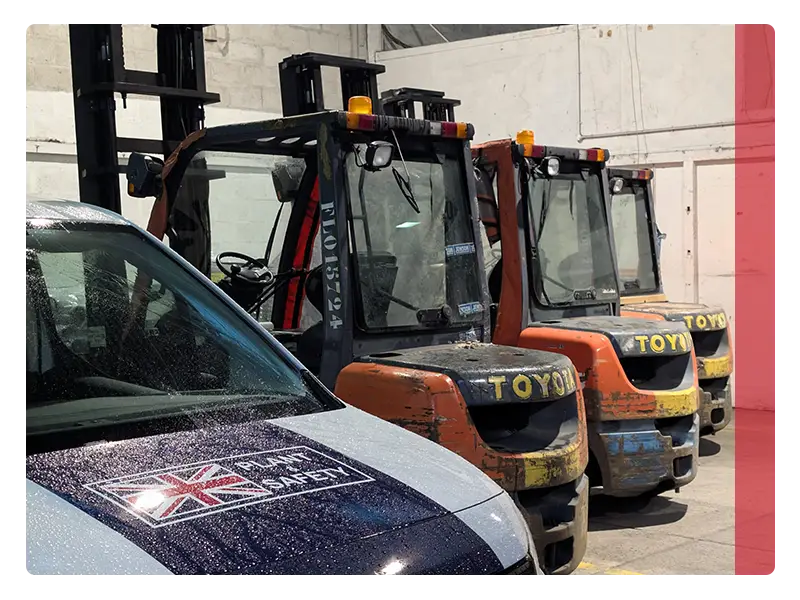
Forklift trucks are widely used across warehouses, factories and distribution centres to move and lift goods. Because they are lifting equipment, they must be inspected regularly to ensure they remain safe to operate.
A forklift truck thorough examination is a detailed inspection carried out by a competent person to identify defects that could become dangerous. This inspection is required under the Lifting Operations and Lifting Equipment Regulations (LOLER) and helps employers ensure their equipment remains compliant with UK health and safety law.
Understanding what happens during a forklift truck thorough examination can help duty holders prepare their equipment and maintain safe operations.
A forklift truck thorough examination is a formal inspection of lifting equipment carried out by a competent person. The purpose is to identify defects that could affect the safe use of the equipment.
Unlike routine servicing or scheduled maintenance, a thorough examination focuses on the safety and integrity of the lifting components and structural elements of the forklift truck.
The examination results in a Report of Thorough Examination, which records the condition of the equipment and any defects that require attention.
MORE ABOUT SAFETY REGULATIONS
Forklift trucks are classed as lifting equipment when they are used to lift or lower loads. Because of this, they fall within the scope of the Lifting Operations and Lifting Equipment Regulations 1998 (LOLER).
However, forklift trucks are also classed as work equipment, meaning they are also subject to the requirements of the Provision and Use of Work Equipment Regulations 1998 (PUWER).
Together, these regulations require that lifting and work equipment is:
› Safe for use
› Properly maintained
› Inspected at suitable intervals
› Examined by a competent person where required
Regular thorough examinations and inspections help identify wear, damage or mechanical issues before they lead to equipment failure or workplace accidents. This helps employers maintain safe working environments and ensure compliance with UK health and safety legislation.
Key Components Checked During a Forklift Truck Thorough Examination
A forklift truck thorough examination and inspection typically covers the following key areas:
Load Handling Mechanism (LOLER 1998)
The load handling mechanism is inspected to ensure the lifting components are safe and functioning correctly. This includes the forks, carriage, mast assembly, lifting chains and hydraulic lifting systems.
Braking Systems (PUWER 1998)
Braking systems are assessed to confirm the forklift can be controlled safely and brought to a stop effectively during operation.
Steering Systems (PUWER 1998)
Steering components are examined to ensure the operator can safely manoeuvre the forklift truck during use.
Traction Systems (PUWER 1998)
The traction system, including tyres, wheels and drive components, is inspected to ensure the forklift can operate safely within the workplace environment.
Safety Systems (PUWER 1998)
Safety devices such as warning alarms, operator protection systems and other safety features are checked to confirm they are present and functioning correctly.
General Structure (PUWER 1998)
The overall structural condition of the forklift truck is inspected for signs of damage, wear, cracks or distortion that could affect the safety or stability of the equipment.
Inspection of Forklift Stability and Safety
A key part of the examination is assessing whether the forklift remains stable and safe when performing lifting operations.
This includes reviewing:
› Stability of the lifting mechanism
› Condition of tyres and wheels
› Overall operational safety
Maintaining stability is essential to prevent overturning incidents or dropped loads.
What Happens if Defects Are Found?
If defects are identified during the examination, they will be recorded in the Report of Thorough Examination.
Defects may be classified based on their severity, and some may require immediate attention before the equipment can continue to be used safely.
Duty Holders are responsible for ensuring any issues identified are addressed and repaired where necessary
Who Can Carry Out a Forklift Truck Thorough Examination?
Forklift truck thorough examinations must be completed by a competent person.
A Thorough Examination cannot be replaced by a service, and a service is not a legal substitute for the examination. Thorough Examinations and Inspections are a statutory requirement under LOLER 1998 and PUWER 1998 Regulations, and should be completed by a competent person who is independent and impartial from the service provider.
Supporting Safe Forklift Operations
Regular forklift truck thorough examinations are an important part of maintaining safe workplaces. They help identify potential hazards, ensure lifting equipment remains compliant with regulations, and reduce the risk of workplace incidents.
Duty Holders should ensure that forklift trucks are inspected at appropriate intervals and that any defects identified during examinations are addressed promptly.
Need a Forklift Truck Thorough Examination?
If your business operates forklift trucks or other lifting equipment, regular inspections are essential to ensure safety and compliance.
Plant and Safety provides professional Thorough Examination and Inspection services to support organisations in meeting their statutory obligations.
Information provided on this page is based on the Lifting Operations and Lifting Equipment Regulations 1998 (LOLER), the Provision and Use of Work Equipment Regulations 1998 (PUWER), and associated guidance issued by the Health and Safety Executive relating to the inspection and maintenance of lifting equipment. The scope and frequency of vehicle lift inspections and thorough examinations should be determined by a competent person, taking into account the type of equipment, its usage, operating environment, and the risk of deterioration or failure.
Related Compliance Topics
for Industrial Doors
LOLER Inspection Testing and
Thorough Examination Services →
MORE INFORMATION ON FORKLIFT TRUCK INSPECTIONS
Ensure your forklift trucks and Material Handling Equipment remain safe, compliant, and ready for operation. Our competent engineers provide independent forklift inspections and thorough examinations in accordance with LOLER 1998 and PUWER 1998.
Call 0330 113 7920 or contact us online to arrange your forklift inspection.
How can we help?
To learn more or if you have any questions, please feel free to call or email us. You can also request a call back using our online form.
T: 0330 113 7920
E: sales@plantandsafety.co.uk
Useful Links